NASA Discovers Giant New Moon Crater Formed by a 2024 Impact
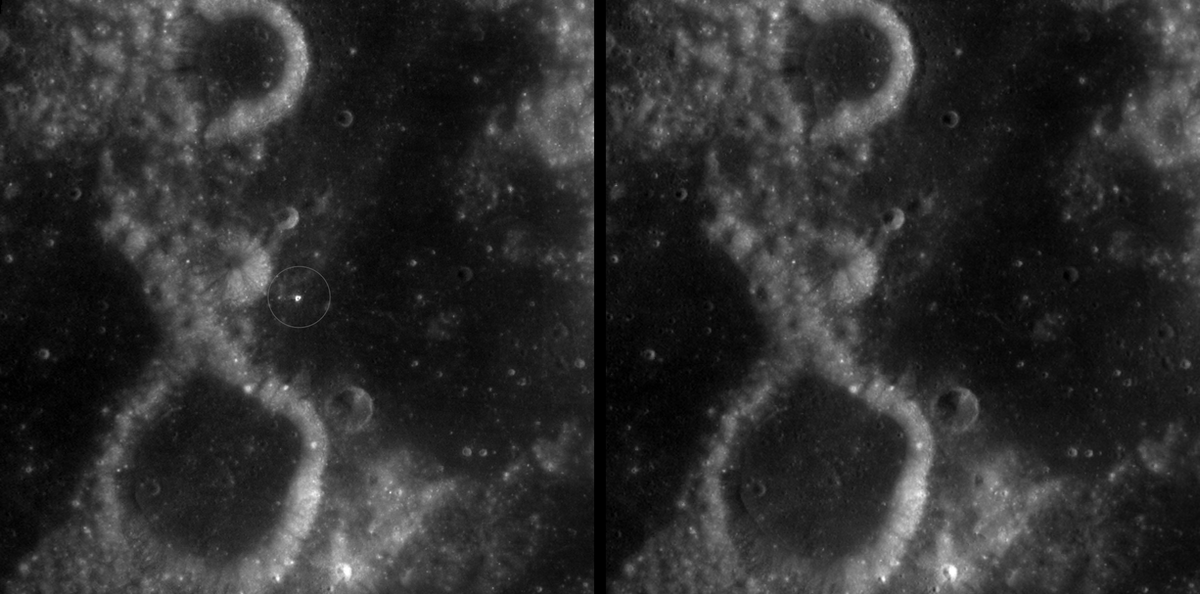
NASA’s Lunar Reconnaissance Orbiter has revealed a massive new crater on the Moon that formed after a space rock struck the lunar surface in 2024 — and scientists say the event was rare enough to provide an unusually valuable glimpse into how lunar impacts reshape the Moon.
Named McGetchin crater, the newly identified feature measures about 222 meters (728 feet) across and 43 meters (141 feet) deep. NASA says it is the largest newly formed impact crater discovered anywhere in the solar system.


The crater was not spotted when the impact happened. Instead, researchers found evidence of the collision months later by comparing images collected by the Lunar Reconnaissance Orbiter (LRO) before and after the event.
What Happened on the Moon?
Scientists estimate that McGetchin crater formed sometime between April 11 and May 22, 2024, when an asteroid or comet fragment struck the lunar surface.
NASA estimates that the incoming object may have been roughly the size of a three- to six-story building. The impact occurred on the Moon’s eastern side, at the boundary between rugged lunar highlands and a broad, relatively flat mare.
The resulting crater stretches roughly the length of two American football fields.
The crater is surrounded by a bright blanket of material thrown outward during the collision. Detailed LRO imagery showed that the impact excavated and redistributed lunar material across a much wider area than the crater itself.
Scientists Didn’t See the Impact in Real Time
One of the most unusual aspects of the discovery is that the collision went unnoticed when it occurred.
LRO had already been photographing the Moon for years, giving researchers before-and-after images that ultimately allowed them to identify the newly created crater.
NASA says image-processing specialist Robert Wagner discovered the feature during a routine data check on October 24, 2025. He noticed an unusually large bright area surrounded by a darker halo while examining global lunar maps.
Researchers subsequently used LRO’s higher-resolution Narrow-Angle Camera to examine the location in much greater detail.
Those observations confirmed the crater’s dimensions and showed the extensive changes to the surrounding terrain.
A Rare Lunar Event
The size of McGetchin makes the impact particularly important.
Researchers estimate that an event capable of producing a crater this large happens on the Moon roughly once every century or longer. NASA describes it as a “once-in-a-century” type of event, while the research places the estimated frequency at approximately once every 132 years.
That rarity means scientists effectively have a natural laboratory that was captured shortly after formation.
Unlike ancient lunar craters that have been gradually modified by subsequent impacts and other processes, McGetchin is extremely young on geological timescales.
Its relatively fresh condition gives researchers an opportunity to study how material behaves immediately after a major lunar collision.
The Impact Changed More Than the Crater
The collision also disturbed lunar material far beyond the crater itself.
One of the two studies published in Science Advances examined the ejecta produced by the impact. Researchers found that material was thrown outward across an area extending more than 100 kilometers from the crater.
Another study examined the thermal effects surrounding the new crater.
NASA’s LRO Diviner instrument detected a roughly 4-mile-wide (7-kilometer-wide) area around McGetchin that was significantly colder at night than the surrounding surface. NASA reported a temperature difference of about 16 degrees Fahrenheit (9 degrees Celsius).
Scientists attribute the effect to the way the impact disturbed and loosened the Moon’s upper layer of soil, known as regolith.
The Moon’s Surface Is Constantly Being “Gardened”
The discovery also provides new information about the evolution of the lunar surface.
The Moon has no substantial atmosphere to burn up incoming space rocks, meaning objects that would often break apart or slow down in Earth’s atmosphere can strike the lunar surface directly.
LRO has been observing the Moon since 2009 and has identified numerous newly formed craters and other surface changes. NASA says researchers have identified at least 1,000 new impact craters during the mission, along with roughly 100,000 additional surface changes associated with impacts and ejecta.
The observations indicate that lunar soil is being overturned by impact ejecta more frequently than some previous estimates suggested.
That has an unexpected consequence for one of the Moon’s most famous archaeological traces.
What About the Apollo Footprints?
The discovery also challenges the popular idea that footprints left by Apollo astronauts will remain untouched indefinitely.
Because the lunar surface is continually disturbed by impacts and redistributed material, those footprints will eventually be buried or erased.
NASA researchers estimate that the upper layer of lunar soil is overturned by ejecta on a timescale of roughly 80,000 years, meaning even the historic Apollo tracks are not permanent features of the lunar landscape.
Why the Discovery Matters for Future Moon Bases
The finding has significance beyond lunar geology.
NASA and other space agencies are planning increasingly ambitious robotic and human activity on the Moon. Future infrastructure will have to operate in an environment where high-speed debris can strike the surface without warning.
The LROC team specifically noted that the McGetchin impact demonstrates why long-lived lunar infrastructure needs to account for high-velocity particles generated by distant impacts.
Researchers now want to better understand how far ejecta from impacts like McGetchin can travel and how much material can be thrown toward potential lunar infrastructure.
That information could eventually help engineers assess risks and design structures for future lunar operations.
NASA’s LRO mission itself is already being used to support future exploration by mapping the Moon’s surface and helping identify areas relevant to robotic and human missions.
What Happens Next?
Scientists will continue analyzing McGetchin crater and the material surrounding it.
Because researchers have both pre-impact and post-impact observations, the site offers an unusually detailed opportunity to compare the Moon before and after a major collision.
The data could improve models of lunar impact physics, ejecta distribution and how quickly the Moon’s surface changes.
For future explorers, the research may also provide better estimates of the risks posed by impacts occurring elsewhere on the Moon.
Current Status
McGetchin crater is now officially recognized as a lunar crater and was named after American geologist and planetary scientist Thomas McGetchin, who served as director of the Lunar and Planetary Institute. The International Astronomical Union approved the name in May 2026.
The crater is approximately 222 meters wide and 43 meters deep, and scientists believe it formed during an impact in spring 2024.
Its discovery demonstrates that even in an era of detailed lunar mapping, significant changes can remain hidden in enormous volumes of spacecraft data until researchers compare observations taken at different times.
FAQ
How big is the new Moon crater?
McGetchin crater is approximately 222 meters (728 feet) wide and about 43 meters (141 feet) deep.
When did the Moon impact happen?
Scientists estimate that the impact occurred between April 11 and May 22, 2024.
What caused the McGetchin crater?
Researchers believe a fragment from an asteroid or comet struck the Moon. The object may have been roughly three to six stories in size.
When did NASA discover the crater?
The feature was identified in LRO data during a routine analysis on October 24, 2025.
Will Apollo footprints remain on the Moon forever?
No. Lunar impacts continually redistribute the Moon’s surface material. NASA researchers estimate that the upper lunar soil is substantially overturned on timescales of roughly 80,000 years.

